When Is a Black Belt a Black Belt?
What does a black belt truly represent in modern Brazilian Jiu-Jitsu? Drawing on 20+ years of training and 15 years of coaching, this piece questions fast-track promotions and marketing-driven standards, and calls for a renewed focus on self-defence, character, and service.


Jamie Murray
Co—Owner and Head Coach
Jamie A. Murray is the co-owner and head coach of Renegade BJJ Academy in Kensington, a thriving martial arts gym serving Melbourne’s inner-west since 2010. A third-degree Brazilian Jiu-Jitsu black belt with the Australian Elite Team, Jamie is passionate about using grappling to foster positive change across Kensington, the Western suburbs and beyond.
He is a Ridley Theological College graduate and a seasoned competitor in national and international BJJ tournaments. Jamie has coached students to the highest levels of the sport, including the UFC, and continues to compete himself.
At Renegade BJJ, Jamie champions a culture of care, learning, and community, creating a supportive space where people of all levels can grow through the discipline and lifestyle of BJJ.
Introduction: The Question That Few Ask in Brazilian Jiu-Jitsu
The journey to earning a black belt in the world of Brazilian Jiu-Jitsu (BJJ) is often portrayed as the ultimate achievement. But the more I coach and observe, the more I realise we rarely ask the deeper question: What does a black belt really mean today?
Is it simply the number of years on the mats, the competition record, or is there something more, such as consistency, teaching, character, and service?
And further: in 2025, with belts being awarded rapidly and marketing louder than ever, has the title of black belt started to lose some of its meaning?
As a coach who has handed out 30 black belts and as a member of the Australian Elite Team (with around 150 black belts), I believe it’s healthy that we challenge our own assumptions.
My Journey & What I’ve Seen in BJJ Classes
I started training BJJ in 2002 in Bendigo. Resources were scarce and the training was brutal. By 2003 I moved to Melbourne, seeking more training. At the time, Australia had only three black belts that I recall: John Will, Peter de Been, and John Donahue. These guys were pioneers, no hype, no shortcuts and much respect to their achievements.
Fast-forward twenty-something years. With fifteen years of full-time coaching, I’ve awarded 30 black belts, over 70 brown belts, 150 purple belts, and nearly 300 blue belts. I coach under the banner of the Australian Elite Team, a network of around 2,000 students and roughly 150 black belts.
I’ve seen what the black belt looked like when it meant something and I’ve seen what happens when it doesn’t.
In 2017, I had the privilege of training at multiple academies in Brazil under the guidance of my friend and world-class 5th-degree black belt Gustavo Falciroli. There, I saw firsthand how a promotion was earned: years of hard training, competition, teaching, life balance, and character. They didn’t promote because you paid big or had a flashy Instagram. They promoted because you lived the art.
While in Brazil, I attended the largest grading in BJJ history (to that time) on December 4th, 2017, held in São Paulo by Roberto Godoi of G13 BJJ, where 1,200 belts were awarded. It was amazing to witness.
Back in Australia, I’ve seen some different signals emerging and it’s enough to ask the hard question:
When is a black belt a black belt?
The Provocative Questions We Need to Ask About BJJ
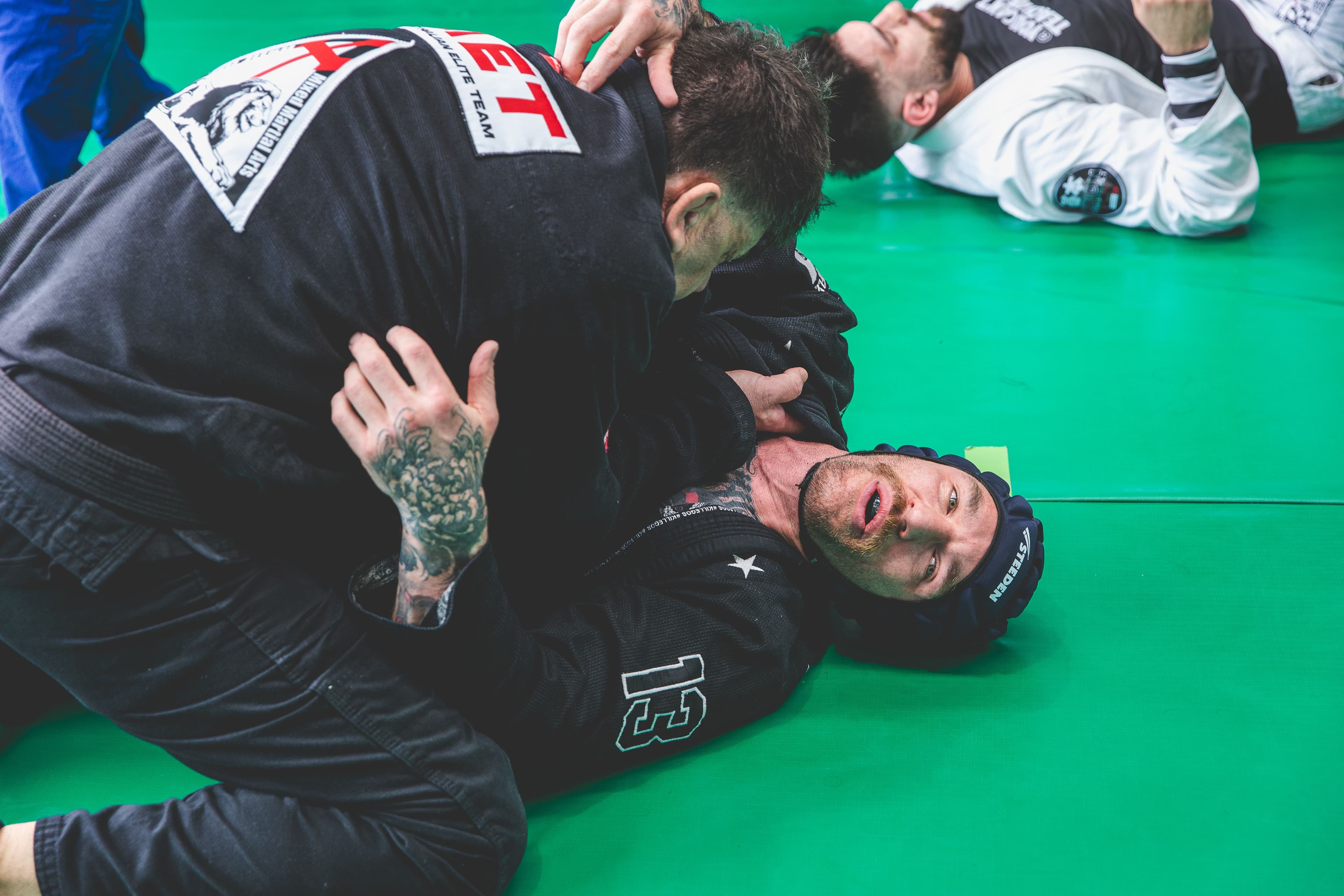
- If someone receives a black belt after just 3–4 years of training, is it equivalent to someone who spent 10–15 years rolling, competing, and teaching?
- Does the value of the black belt diminish if standards loosen?
- When a black belt doesn’t teach, doesn’t contribute to the community, and doesn’t roll regularly, what does the belt represent?
- Are we rewarding marketing and income over mastery and service?
These aren’t comfortable questions — but they’re necessary.
The Controversies: Naming Names in Brazilian Jiu-Jitsu
Derek Moneyberg
One of the flashpoints of this discussion is Derek Moneyberg’s promotion to black belt in approximately 3.5 years, yes, three and a half years under the tutelage of Jake Shields.
His public announcement claimed:
“I got it in about 3.5 years. Zero days missed, because no excuse is good enough to give up on your goals.” BJJ Eastern Europe
He also claimed thousands of hours of study, saying:
“I spent more than 3,000 hours when I wasn’t training, thinking about it and making the adjustments in my head…” BJJDOC
The reaction was explosive. Many in the BJJ community questioned whether fundamental live-rolling competence, competition experience, and teaching credentials had been bypassed.
Mikey Musumeci weighed in bluntly:
“He definitely does not look like a black belt when he’s physically doing those positions… He does those moves with socks on. There’s no grip, I don’t know how he does it.” Jiu-Jitsu Legacy
And:
“Would I give anyone a black belt in just 3.5 years? No.” Jiu-Jitsu Legacy
Meanwhile, Shields publicly defended the promotion, while admitting the standards were different:
“If Derek was a 22-year-old competition guy I probably wouldn’t give him his black belt quite yet. But he’s a 46-year-old businessman.” BJJDOC
Dr. Mike Israetel
Another example is Dr. Mike Israetel, sports scientist and fitness personality. His promotion wasn’t under the same firestorm, but it raised similar questions about what we value.
He reflected:
“I’m bad at almost everything I start. I’m a slow learner. I stumble a lot. I get frustrated easily. I think about quitting constantly… I stick around and do my best. I find some shaky ground. I improve. I master. I innovate. I teach others.” — JitsMagazine.com
Solid words. But how does this compare to someone who spent fifteen years grinding through injuries, competitions, and hundreds of teaching hours? What message does that mismatch send to the broader BJJ community?
Why This Matters for You (and for BJJ Academies)
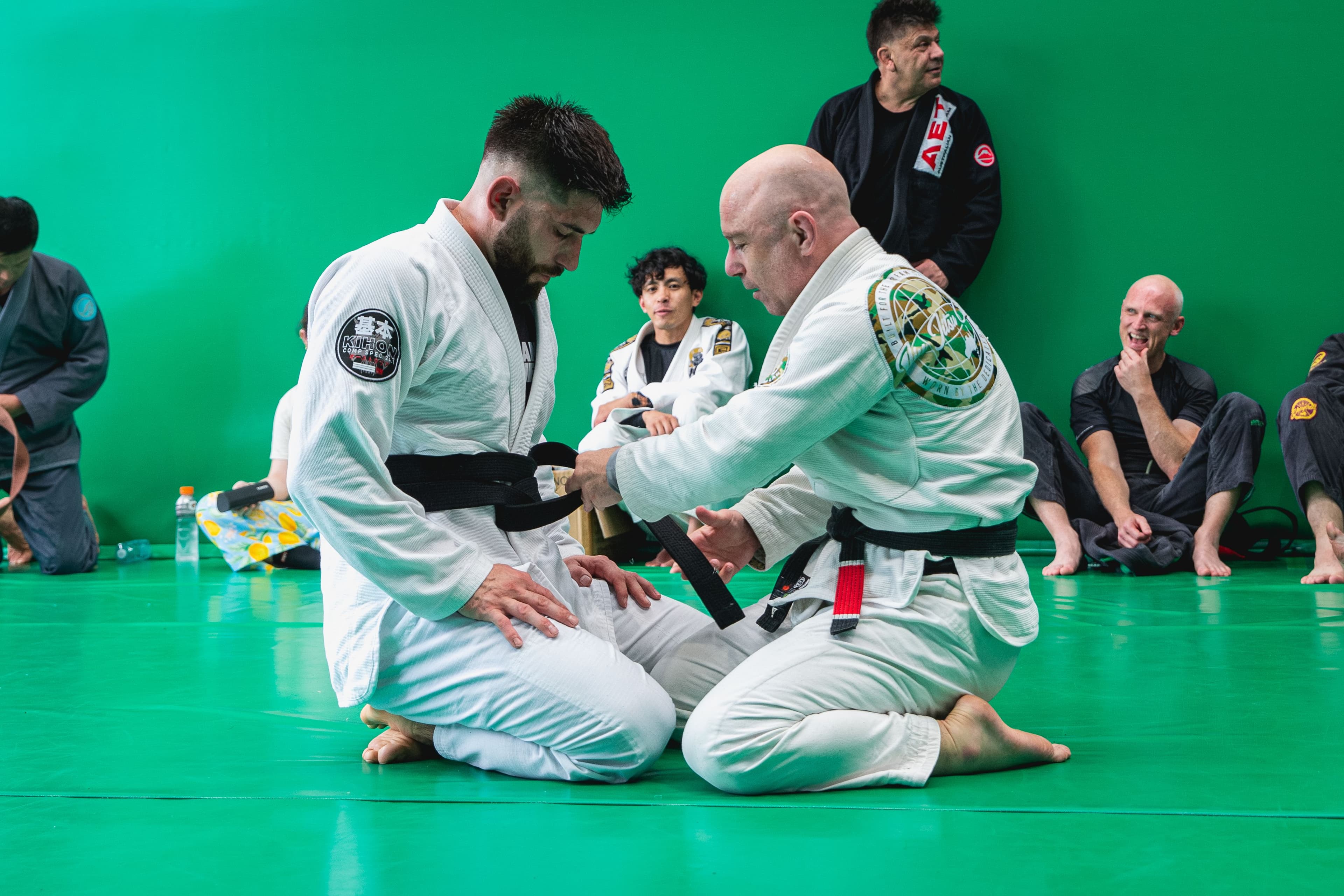
If you train at a local BJJ academy, whether in Kensington or anywhere else, this matters. The culture of rank affects you.
If belts lose meaning, students lose faith. Competitors lose respect. Coaches lose legitimacy. And the art’s integrity comes into question.
When I award a black belt in my academies, I do so because the student has:
- Technical proficiency under resistance
- Long-term consistency (typically 8–12+ years)
- Competitive exposure (not always mandatory, but heavily valued)
- Teaching and leadership contribution
- Humility and character
That’s what I believe a black belt should reflect.
If we don’t guard that standard, we risk watering down the title. Soon, when someone hears “black belt,” they might ask, “Was this earned or bought?”
And if the community believes it’s more about marketing than mastery, we undermine the art.
A Reality Check from the Top of Brazilian Jiu-Jitsu
Gordon Ryan:
“Belts don’t matter. I was submitting black belts in competition as a 17-year-old blue belt… The number of people I would give a black belt to on earth based on my standards, I could count on my hands.” BJJ Eastern Europe
His view: a black belt doesn’t automatically equal mastery. The rank is only as good as the skill and depth behind it.
Caio Terra:
“When I looked down, there was a black belt on my waist… and I was in second place, and I really didn’t want to get a black belt when I lost.” Jiu-Jitsu Legacy
His point: humility and competence matter more than ceremony.

The Forgotten Core: Self-Defence as the True Essence of BJJ
One area that modern sport BJJ often overlooks and where the true meaning of the black belt is being tested is self-defence.
The founders of Brazilian Jiu-Jitsu, particularly the Gracie family, built the art not around sport points or flashy berimbolos, but around real-world survival.
Helio Gracie said it clearly:
“Jiu-Jitsu is for the protection of the individual, the older man, the weak, the child, the lady against a stronger aggressor.”
For Helio, technique had to work when you were tired, smaller, or under pressure. That was the foundation of what became Gracie Jiu-Jitsu and by extension, BJJ.
Later, Relson Gracie put it bluntly:
“If you don’t know self-defence, you are not a real black belt.”
That quote cuts deep. Because in today’s environment, a growing number of practitioners can invert, heel-hook, and play guard with precision, but would they be lost if someone threw a punch?
The Gracies repeatedly emphasised that self-defence is the soul of Jiu-Jitsu. Rorion Gracie even built the original UFC to prove that these principles worked in reality and not just in tournaments.
In his words:
“Sport Jiu-Jitsu is one expression of the art, but it is not the complete art. The complete art begins with self-defence.” Rorion Gracie
When a black belt is awarded, it should therefore reflect not only the ability to dominate on the mats, but also to protect oneself and others. If that element is missing, then does the belt represent all of what Jiu-Jitsu truly is?
As a coach and BJJ academy owner, my focus has always been on the community aspect of Jiu-Jitsu. I’ve tried to preserve that balance between competition and self-defence, sport and survival. Yet I’ve come to believe that self-defence is a by-product of BJJ training on multiple levels.
It’s not just the ingrained ability to control a ground situation, or the exposure to the intensity of someone trying to choke your lights out. It’s the environment, the community, and, by extension, the lifestyle.
Think about it. Self-defence extends beyond techniques and escapes; it’s about situational awareness and decision-making. If I’m scheduled to be at the academy at 9 a.m. on a Saturday morning for comp training or rolling rounds, it’s far less likely I’ll be out at clubs or pubs late on Friday night putting myself in risky situations. In that sense, I’ve already exercised self-defence.
The BJJ lifestyle itself promotes discipline, routine, and accountability. It naturally steers you toward healthier habits and environments. In that way, Brazilian Jiu-Jitsu doesn’t just teach self-defence, I would argue it creates it by default.
When Helio Gracie was asked what separated BJJ from other martial arts, his answer was simple:
“Efficiency, patience, and real-world application. A fight is not won by who is stronger, but by who can remain calm and apply leverage.”
That’s the philosophy that shaped the early black belts and the standard we must return to.
My Coaching Reality & What I Stand for in Brazilian Jiu-Jitsu
In my 15-year full-time coaching journey:
- 30 black belts awarded
- 70+ brown belts
- 150 purple belts
- 300 blue belts
All under the Australian Elite Team (2,000 students, ~150 black belts). I’ve seen what works and what doesn’t.
When I hand someone a black belt, I expect it to carry weight that lasts decades, representing the reputation of my academy, the ethos of the art, and the trust of our community.
That means not just technical competency or competition records, but composure under pressure, real self-defence awareness, and respect for the lineage that built this art from the favelas to the world stage.
Out of the Grey Zone: Two Paths for Brazilian Jiu-Jitsu
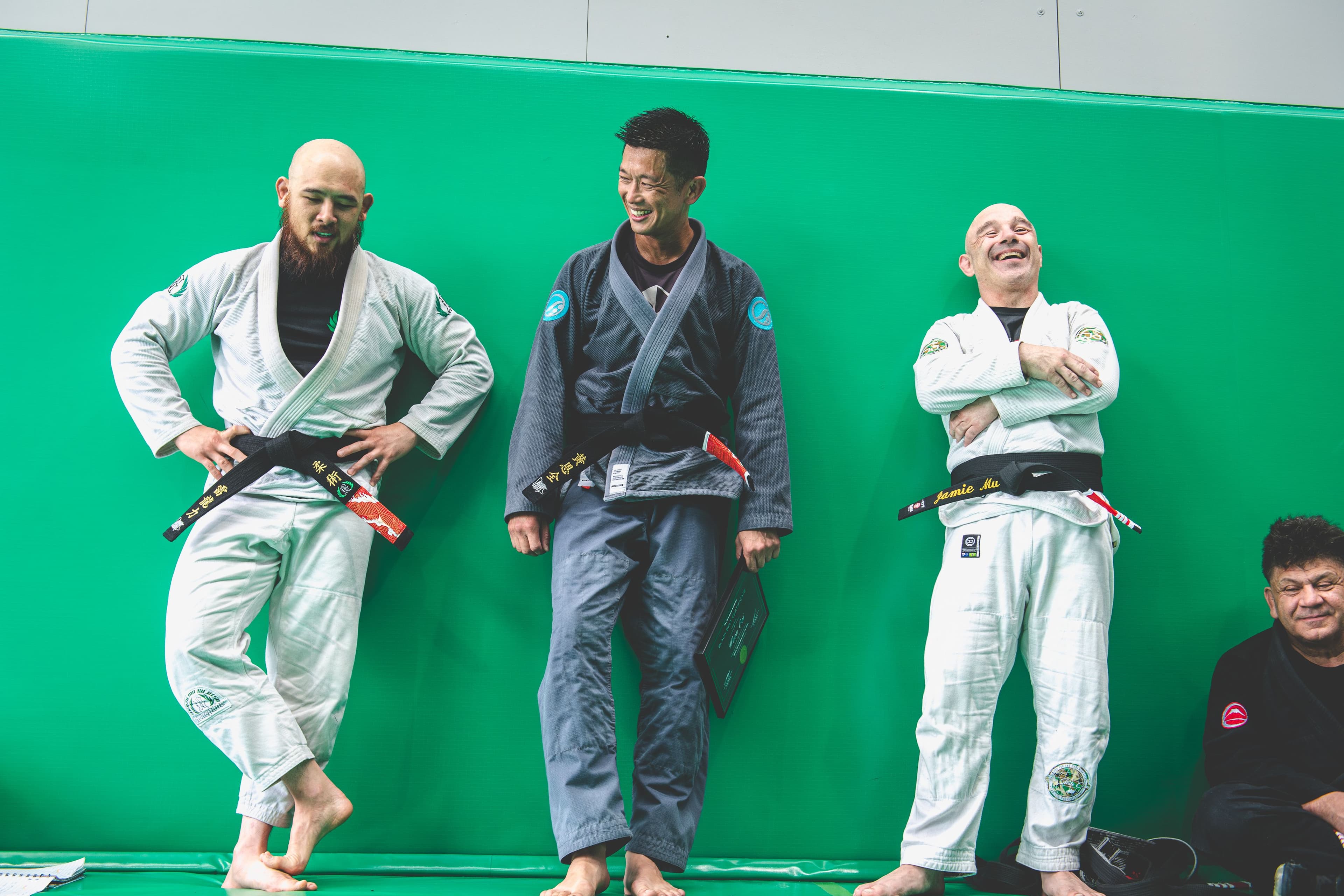
- The Traditional Grind Path: 8–15+ years of consistent training, competition, teaching, resilience through injuries and life distractions.
- The Accelerated Path: Big resources, private coaching, fast-track promotions, heavy marketing.
Both exist. But if we treat them as equal, we erode the value of the black belt, and risk losing the art’s identity.
Final Thoughts: A Call for the BJJ Community
If you walk into a BJJ academy, in Kensington or anywhere else, ask:
- What are the criteria for promotion?
- Does the coach include self-defence, competition, character, and teaching?
- Is the belt awarded for show, or for substance?
The question “When is a black belt a black belt?” doesn’t have one universal answer. But it should have one universal respect.
A black belt should represent competency, integrity, contribution, and service, not just years or marketing.
So I’ll leave you with this:
If you’re earning your black belt, know what it stands for.
If you’re awarding a black belt, know what you’re handing out.
If you’re joining a BJJ academy, know what they believe the belt means.
Because if we don’t guard the meaning of the rank, we don’t just let down individual up-and-comers, we let down the whole art.
Train hard. Promote wisely. Question boldly. Defend yourself and the legacy of the art we love.
Looking for high quality BJJ Classes near me in Kensington or Melbourne?
Send an email to info@renegadebjj.com.au and join us for a free BJJ class.